
About Journal
Life Science Research Communications (LSRC)
Abbreviated form: Life Sci. Res. Commn.
A Peer-Reviewed International Journal Dedicated to the Life Sciences
ISSN: Online – 3041-0851
Frequency: Triannually (3 issues per year)
About the Journal
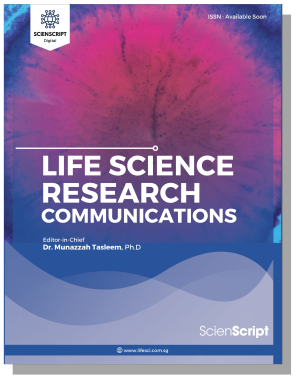
Cover — Life Science Research Communications
Life Science Research Communications (LSRC) [Abbreviated form: Life Sci. Res. Commn.] ISSN: 3041-0851 (Online) is an esteemed, peer-reviewed international journal dedicated to the broad spectrum of research disciplines encompassed within the life sciences. With a commitment to high-quality research, innovation, and scientific integrity, LSRC offers a platform for scientists, researchers, and academicians to share their discoveries, insights, and expertise with a global audience.
From the intricate molecular pathways within cells to the vast complexities of ecosystems, LSRC covers a diverse range of topics. We celebrate the multifaceted nature of life science research by promoting interdisciplinary studies, embracing modern technological advancements, and encouraging the fusion of traditional biological knowledge with contemporary methodologies.
Key features of LSRC:
- Broad Coverage: LSRC’s purview spans molecular biology, genetics, ecology, physiology, bioinformatics, biotechnology, evolutionary studies, and much more.
- Rigorous Peer Review: Each submission undergoes a stringent peer-review process, ensuring that only the most robust, original, and impactful research is published.
- Timely Publication: Recognizing the fast-paced nature of scientific discovery, LSRC is committed to a swift yet thorough review process.
- Open Access Option: To enhance global accessibility and the democratization of knowledge, LSRC offers an open access option, making research freely available to all.
- Ethical Standards: LSRC holds itself and its contributors to the highest ethical standards, ensuring transparency, honesty, and respect for the global scientific community.
- Community Engagement: Beyond traditional research articles, LSRC welcomes reviews, opinion pieces, methodological notes, and commentaries, fostering a vibrant and engaged community dialogue.
In its quest for scientific excellence and exploration, Life Science Research Communications stands as a beacon for all researchers eager to contribute to the expanding horizons of life sciences. Join us on this journey of discovery, collaboration, and knowledge dissemination.
Aim and Scope
Aim
Life Science Research Communications (LSRC) seeks to be a premier interdisciplinary journal that provides a unified platform for the global dissemination of vital research findings, novel methodologies, insightful reviews, and thought-provoking discussions in the expansive domain of life sciences. We aim to foster an integrative approach, encouraging the blending of traditional biological research with modern techniques and ideas, with a goal to catalyze groundbreaking advancements in the life sciences. LSRC is committed to enhancing public health, understanding of life processes, and the relationship between organisms and their environments by ensuring that pivotal life science discoveries are shared widely, promptly, and effectively.
Scope
- Diverse Research Domains: LSRC covers a vast array of subjects under the life sciences umbrella, including but not limited to molecular biology, genetics, physiology, biochemistry, cell biology, ecology, evolutionary studies, and more.
- Technological Advancements: Submissions related to bioinformatics, biotechnology, computational biology, and systems biology are greatly encouraged.
- Methodological Innovations: LSRC welcomes papers that detail new methodologies or significant refinements to existing protocols which can be game-changers for life science researchers.
- Reviews and Meta-analyses: Comprehensive reviews, meta-analyses, and perspectives that offer a deep dive into particular areas of life sciences are invited.
- Interdisciplinary Collaborations: LSRC is open to papers that merge life sciences with fields like physics, chemistry, astronomy, or even the social sciences, as long as the core focus remains rooted in life sciences.
- Rapid Communications: For findings that are exceptionally timely and of significant importance, we offer a rapid communication channel to ensure swift peer-review and publication.
- Open Data and Reproducibility: Submissions which include datasets, detailed protocols, and tools that allow for reproduction and validation of experiments will be given preference.
- Ethical and Social Implications: LSRC invites discussions and debates on the ethical, legal, and social implications of life science research.
- Outreach and Education: Articles that discuss strategies for science education, public outreach, or the bridging of the gap between science and society are welcome.
Abstracting & Indexing Information
- Google Scholar
- CrossRef / DOI
Journal Indexing
Editor-in-Chief
Dr. Munazzah Tasleem, Ph.D
1BIAltesse LLC, 5109 Silverton Ln,
Louisville, Kentucky 40241, United States.
2Guest Faculty, Jamia Hamdard, New Delhi, India.
Email: editorial.office@lifesci.com.sg